4x4x4 cube solving guide
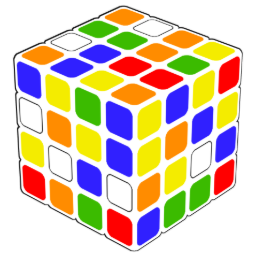
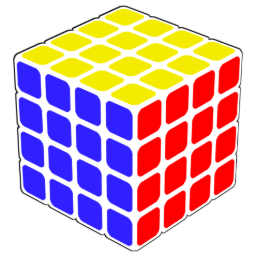
The goal of this guide is for you to learn to solve the 4x4x4 cube in the simplest possible way. We will use the reduction method: first we will reduce the 4x4x4 to a 3x3x3 and then we will solve it as if it were one.
To follow it you need to know how to solve the 3x3x3 and know the 4x4x4 notation, especially the inner layers and the two-layer moves.
The solution consists of 4 steps:
- Centers: form the 6 blocks of 2x2 centers, each one on its own face.
- Edges: join the twin edges to form the 12 double edges.
- Solve it like a 3x3x3: with the centers and the edges done, solve the cube like a 3x3x3.
- Parities: solve the two situations that cannot happen on the 3x3x3.
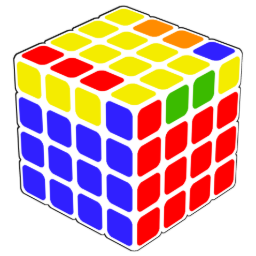
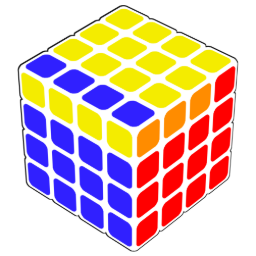
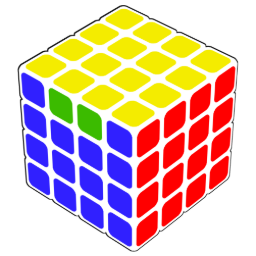
First step: Centers
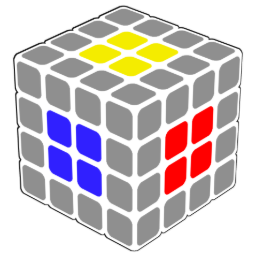
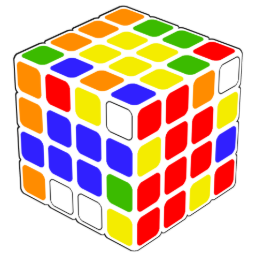
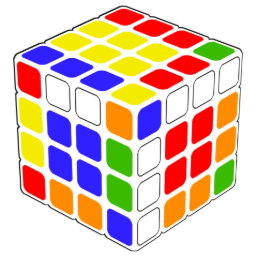
In this first step we have to form the 6 centers: on each face, a 2x2 block of center pieces of the same color. Since the centers of the 4x4x4 are not fixed, the order and the color scheme matter: if we put a center on the wrong face, we will not notice until the end.
- Start with the white center. Look for white center pieces and join them two by two until you form the 2x2 block. This first center can be done intuitively, without algorithms, because there is nothing yet that could be undone.
- Make the yellow center on the face opposite the white one. Now you have to be careful not to break the white one: put it on the bottom face and work with yellow on the top face.
- Form the 4 side centers. With white on the top face and green on the front face, red must go on the right, blue at the back and orange on the left. If you put them in a different order, you will not notice until the edges do not fit.
To form the side centers without breaking the ones you already have, the easiest way is to join pairs of centers into bars of two and insert them into their face with a two-layer move. For example, if the front face is missing its right column and you have a bar of that color in the left column of the top face, this algorithm takes it there:
Rw U2 Rw'
Notice that Rw raises the right column of the front face to the top face, U2 brings the bar right above that column and Rw' lowers it to the front face. If the bar is not in the left column of the top face, place it there first by turning the top face with U.
Swapped centers
If after finishing the centers you notice that two of them are swapped (for example, the top one and the front one), you do not need to start over. Put them on the top face and on the front face and apply this algorithm, which swaps them whole:
Rw' F2 Rw2 U2 Rw'
Second step: Edges
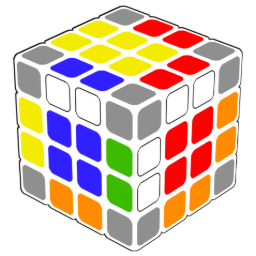
Now we have to join each edge with its twin to form the 12 double edges. The goal is only to pair them: you do not need to put them in their place, we will do that in the next step, as if it were a 3x3x3. During this step the centers are broken for a moment, but each algorithm puts them back in place.
Pairing the edges
Look for two twin wings, that is, two edge pieces with the same colors. Looking at the front face, place one in the left column and the other in the right column, both in the second row from the top (just below the top corner). In the animation, the two twins are the blue and red wings: both show blue on the front face and red on the side.
Uw' (R U R' F R' F' R) Uw
How it works: Uw' sets one of the twins aside in the back right edge and brings the other one to the right edge. R U R' F R' F' R, which only moves outer layers, flips this edge so that the wing moves down to the lower row. Finally, Uw brings the wing that was set aside back, right above its twin, and puts the centers back in place.
The algorithm only breaks the two edges where you place the twins (on the left and on the right of the front face). To bring the unpaired edges to the position where you have to do the algorithm, use turns of the outer faces (R, U, F…), which break neither the centers nor the paired edges. Repeat the procedure with all the edges until they are all paired.
Third step: Solve it like a 3x3x3
Goal of this step: with the centers and the edges done, the cube can now be solved like a 3x3x3.
With the centers formed and the 12 edges paired, the 4x4x4 behaves like a 3x3x3. Solve it with the method you use, turning only the outer layers: moves of the inner layers would break the centers and the edges.
While you solve it you may come across a parity. It does not always happen: in many solves the cube is finished like a normal 3x3x3 and that's it. But sometimes, on the last layer, a situation appears that cannot happen on a 3x3x3. You do not need to finish the whole 3x3x3 to find out: it shows at a specific moment, and then you have to go to the fourth step, apply the parity algorithm and come back here to finish the last layer. There are two types:
- OLL parity: when orienting the last layer (making the yellow cross or the OLL), count the edges that have yellow on the top face. On the 3x3x3 there are always 0, 2 or 4; if you have 1 or 3, it is as if one of the edges were flipped. Do the OLL parity and continue.
- PLL parity: when putting the pieces of the last layer in their place (permuting it or doing the PLL), you are left with a case that does not exist on the 3x3x3: for example, only two swapped edges, or no algorithm gives you the case you expect. Do the PLL parity and finish the last layer.
Fourth step: Parities
While you solve it, you may come across two situations that are impossible on the 3x3x3. They are called parities and we will fix each of them with an algorithm.
OLL parity
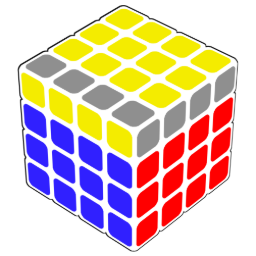
When you reach the last layer, a single double edge may be flipped (or, in general, you may have an odd number of flipped edges): this cannot happen on the 3x3x3. This is the OLL parity.
Hold the cube with the yellow center on the top face and place the flipped edge at the front of the top layer: it is the edge that has yellow facing the front face instead of the top face. Then apply the following algorithm. Afterwards, go back to the third step and continue solving the last layer as usual.
Rw U2 x Rw U2 Rw U2 Rw' U2 Lw U2 Rw' U2 Rw U2 Rw' U2 Rw'
PLL parity
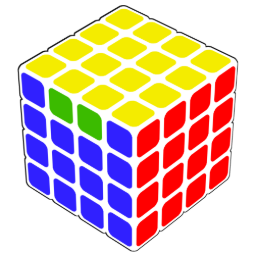
If at the end you are left with two swapped edges, or a permutation of the last layer that does not exist on the 3x3x3, it is the PLL parity.
With yellow on the top face, place one of the misplaced edges at the front of the top layer and apply the following algorithm, which ends with U2: it swaps the front and back edges of the top layer. If the two misplaced edges are opposite each other, put the other one at the back, as in the animation, and the last layer will be solved. If not, the last layer will not be solved, but you will have a normal PLL case: go back to the third step and finish it as on the 3x3x3.
2R2 U2 2R2 Uw2 2R2 Uw2 (U2)
Congratulations! You have solved the cube!