The 4x4x4 cube pieces and notation
The pieces
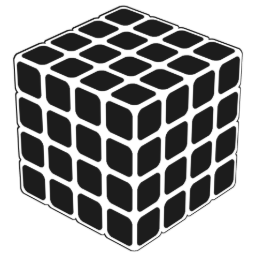
The 4x4x4 has 56 visible pieces of 3 different types. If you already know the 3x3x3 you will find a lot in common, but also an important difference: it has no fixed center piece.
Centers
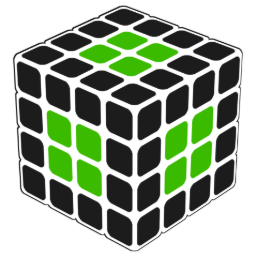
It has 24 centers, 4 on each face. They are single-color pieces, but unlike on the 3x3x3 they are not fixed: when we turn the inner layers, the centers move to another face. That is why on the 4x4x4 we decide the color of each face ourselves when we group the centers on it, and you need to know the color scheme: white is opposite yellow, green is opposite blue and red is opposite orange. With white on the top face and green on the front face, red is on the right.
Edges
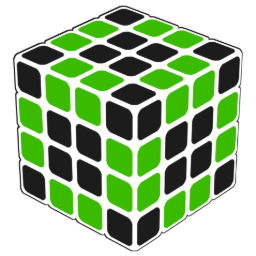
It has 24 edges, with 2 colors each. Each edge has a twin with the same colors, and once we join them they form a double edge, which plays the role of an edge of the 3x3x3. So there are 12 double edges.
Corners
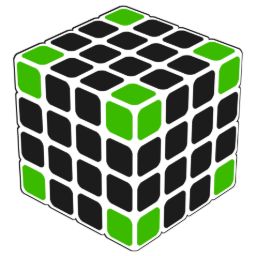
It has 8 corners, with 3 colors each, just like the 3x3x3.
4x4x4 cube notation
To read and write sequences of moves we use a notation very similar to that of the 3x3x3, which I will explain below.
The 6 faces have the same names as on the 3x3x3 and the direction of the turns is also the same: the letter alone means turning the layer a quarter turn clockwise while looking straight at the face, with a ' after the letter the turn is counterclockwise, and with a 2 it is a half turn.
- F: Front - Front
- U: Up - Up
- D: Down - Down
- R: Right - Right
- L: Left - Left
- B: Back - Back
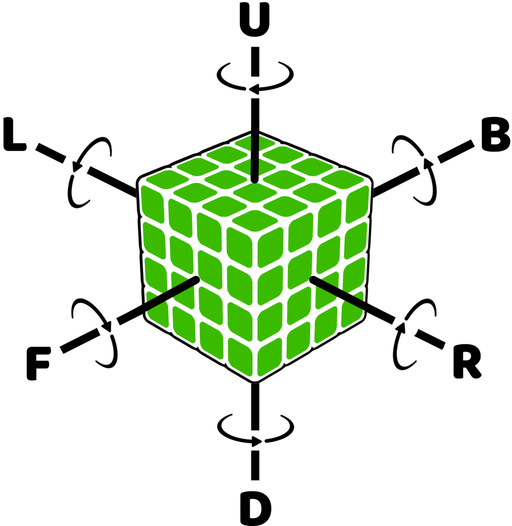
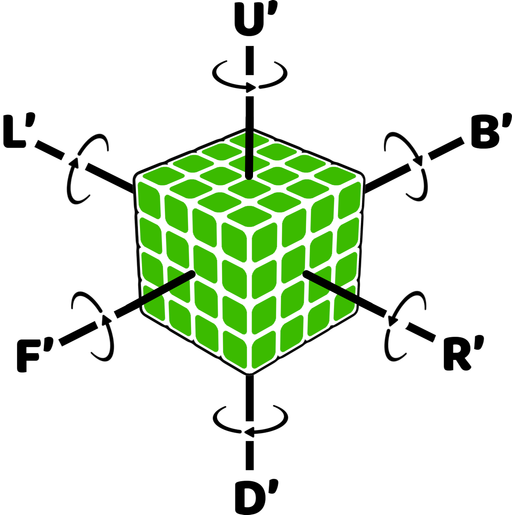
Outer layers of the cube
The outer layers are those of the faces, as on the 3x3x3:
Clockwise:
Counterclockwise:
Inner layers of the cube
Between each pair of opposite faces there are two inner layers. To indicate that we turn only the inner layer next to a face, we put a 2 before the letter: 2R is the inner layer next to R, and it turns in the same direction as R.
Clockwise:
Counterclockwise:
Two-layer moves
We can also turn the outer layer and the inner layer on the same side at the same time. These two-layer moves are written with a w after the letter (Rw, Uw…). In some places you will also find them written in lowercase (r, u…), which means the same.
Clockwise:
Counterclockwise:
Cube rotation moves
Whole-cube rotations are written the same way as on the 3x3x3: x follows R, y follows U and z follows F.
Double moves
Double moves of any layer can be indicated with the number 2 after the letter (R2, 2R2, Rw2…). The direction of the turn does not matter, since whether you turn clockwise or counterclockwise the result will be the same.